Live Data in ABRP Stopped Working for BMW. Nobody Said Why. I Built the Fix.
BMW and MINI lost the Enode connection in A Better Route Planner with no announcement. What broke, your four real options in 2026, and what 7,000 km on a bridge I wrote myself actually taught me.
· Updated · 18 min read
If you drive a BMW or MINI EV and use A Better Route Planner, you'll remember the exact drive where it happened. You pulled out of a charger, glanced at the phone, and ABRP was sitting there with a battery percentage from three hours ago, looking confident and being completely wrong.
The Enode connection stopped working. There was no blog post about it. There still isn't. A forum user reported on 13 November 2025 that he'd received an email from ABRP saying BMW and MINI connectivity via Enode was ending and live data would be turned off from 14 November 2025. Nobody corroborated it, no official announcement ever appeared, and that forum thread remains the only account anyone has.
It gets stranger. ABRP's public "All connections" table lists exactly seven connections: OBD dongle, LeafSpy, Android Automotive, Tesla, Rivian, Porsche and Enode. Neither Generic nor Tronity appears on it, even though both appear in the app. Their public documentation under-reports their own product, so a lot of BMW owners believe they're stuck with a dongle when they aren't.
I drive an iX1. I plan a lot of long trips, including a couple I'll tell you about later. And I wasn't willing to accept the two options that appeared to be left, which were "buy a dongle and leave it dangling out of your footwell forever" or "become a human sensor."
So I built Nexiter LIVE.
This is a long post, because it's the post I wanted to read when I was figuring this out. It covers what broke, what your four real options are in 2026 including the ones that aren't mine, how a third-party app can legitimately feed ABRP at all, how fresh the data really is (with numbers, not marketing), and what it's like to drive 7,000 km on a bridge you wrote yourself.
Part 1: What actually broke
Let's be precise about it, because the internet has been vague.
ABRP never talked to your BMW directly. It went through Enode, a middleware company whose whole business is connecting third-party apps to car manufacturers' APIs. Enode had a pipe into BMW's connected services, ABRP drank from that pipe, and everyone was happy.
Then it stopped. And here's the part that makes this genuinely odd rather than merely annoying: both companies still publish material saying it works.
Enode's own public brands page still lists the BMW iX1 (2022–2025, EU) as supported. ABRP's connections page still lists Enode as an available connection. Open the ABRP app with a BMW selected and there is no way to choose it.
I'm not going to tell you who ended it, because I don't know and neither does anyone else who's written about it. There was no announcement from either side. What I can tell you is what my own iX1 shows today:
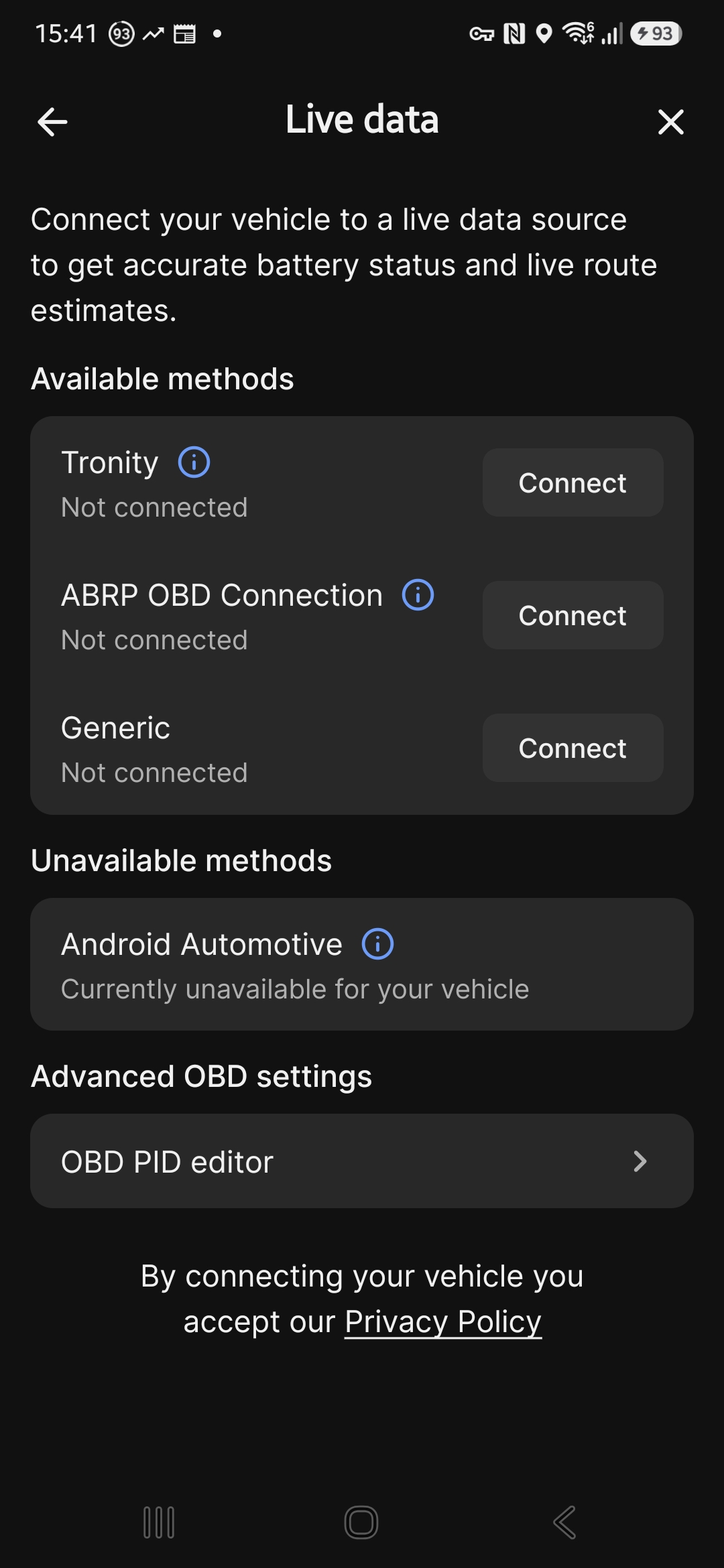
Note what's there and what isn't. Android Automotive appears under "Unavailable methods" with an explanation. Enode doesn't appear at all. Not greyed out, not flagged as unsupported for this vehicle, simply absent from the interface as though it never existed.
That's what a removed integration looks like from the passenger seat: no notice, no tombstone, no explanation, and two public websites that still say it's fine.
The good news is that at almost exactly the time this was going wrong, something much better was becoming available. That's Part 4.
Part 2: Why manual entry ruins ABRP specifically
I want to make this argument properly, because a lot of people think manual entry is a mild inconvenience. It isn't. It breaks the one thing ABRP is genuinely great at.
Google Maps is a routing app. It finds a path. ABRP is a simulation. It models your specific car against elevation gain, ambient temperature, wind vector, your actual driving speed, your heating load, and the charge curve of your specific battery chemistry at a specific state of charge and temperature. Then it predicts what percentage you'll roll into each charger with.
That simulation has a feedback loop. It compares its predicted state of charge against your real state of charge and corrects itself as you drive. It's a control system, and like every control system, it's only as good as its sensor input.
Manual entry doesn't give it a sensor. It gives it one reading, then eight hours of silence.
Here's what that looks like in practice, and every EV driver reading this has lived it. You leave a charger at 80%, feeling great. ABRP says you'll arrive at the next stop with 19%. Somewhere in the middle there's a 600-metre climb you forgot about, a headwind that wasn't in the forecast, and a stretch where you sat at 140 km/h because the road was empty and you're only human.
ABRP still says 19%. It has no idea. It's reciting a prediction it made an hour ago based on a number you typed while holding a coffee.
You discover the truth at the summit, with 9%, doing the thing where you turn off the heating and drive at 90 in the right lane feeling like an idiot.
With telemetry flowing, that same drive goes differently in a boring way. A few minutes in, the arrival estimate quietly drops from 19% to 14%. Further along it's 11% and ABRP suggests adding four minutes at the previous stop. You never have a moment. That's the whole point. The feature is the absence of drama.
Part 3: Your four actual options in 2026
Let me lay out the real landscape, including the options that don't make me any money. If one of the others fits you better, take it. I'd rather you be happy than refunded.
Option 1: Type it in yourself
Cost: free.
Effort: small and constant, which is the worst kind.
Look, it works. Millions of people do it. If you drive urban, charge at home, and use ABRP twice a year for a holiday, this is genuinely fine and you should stop reading and go enjoy your car.
It falls apart on long trips, for all the feedback-loop reasons above, and it falls apart at the exact moment you need it most: mid-drive, rain, a charger you've never used, and you're trying to update a percentage one-handed at 120 km/h. Don't do that.
Option 2: An OBD dongle
Cost: roughly €30 to €80 one-time for a decent BLE unit.
Effort: plug in, pair, mostly forget.
This is the purist option and I have real respect for it. A dongle reads the car's own bus directly, so the data is as fresh as data gets. No servers, no internet dependency, no middleman, and no waiting for the car to decide to phone home. It's also the cheapest route into live data in an ongoing sense: ABRP's help centre states that the OBD connection works on iOS and Android and is available to all ABRP users, not only Premium members.
If you want genuinely real-time data, this is the option. Not mine. I'll explain why in Part 6 and I'm not going to dodge it.
The downsides are physical rather than technical. Something is permanently sticking out of your OBD port, below the steering column, where your knee lives. Owners report varying success with newer BMWs specifically, with some iX owners finding the dongle connects to the phone but not the car.
There's also a security issue that ABRP themselves are refreshingly blunt about: all known OBD BLE dongles on the market have very limited security and will happily accept Bluetooth connections from anyone at certain times, and their advice is not to leave the dongle connected when you're not in the car. That's their warning, not mine, and it's worth reading in full.
If you're comfortable with that and your model is known to work, honestly, buy the dongle. It's a good answer.
Option 3: Tronity
Advertised cost: a free Basic tier, then Premium at €4.90 per month billed
annually or €6.90 billed monthly, and Professional at €14.90 per month billed annually or €16.90
billed monthly. Per vehicle, with a 14-day free trial. Basic only does manual recording, though — see
below.
Effort: an account, link the car, link ABRP. About five minutes when it works.
I want to be fair here, because Tronity is a good product and it does considerably more than I do. It's a full EV telematics platform: trip logging, charging cost tracking per kWh at home versus public, a digital glovebox, a tax-compliant driver's logbook, fleet management. The ABRP link is one feature among many. If you want all of that, Tronity is better than my app, full stop. I'm not building a logbook.
Now the part that led directly to this app existing.
I tried it. I hit authorization errors, so I contacted Iternio support. They replied honestly and promptly: they were aware of issues with Tronity, the authorization errors were coming from Tronity's side and would need resolving with Tronity directly, and the alternative was an OBD dongle, which they linked documentation for.
That's a reasonable answer and I want to be clear I'm not criticising it. They were straight with me about where the fault lay and they pointed me at a working option.
Then I logged into Tronity on a laptop to sort it out, and was quoted roughly €14 a month. At the time I also believed ABRP Premium was required for live data, so what I thought I was looking at was something near €20 a month, indefinitely, to get one number from a car I already own into an app I already use. That was the moment I decided to build something.
That €20 was never real, and I'd rather correct it than quietly drop it. It is what I believed in that moment, not what anyone actually has to pay. ABRP Premium is not required — I have since run Nexiter against a free ABRP account and the live data arrived fine. And I still don't know what Tronity charges to relay telemetry to ABRP specifically: it may need one of their paid tiers, though almost certainly not the expensive one. Their pricing page never mentions ABRP at all, and the €14 I was quoted is simply what my screen said that day.
One more caveat while I'm at it. This is one person's experience, on one car, on one day: I have no idea whether those authorization errors affect anyone else, and I'm not claiming Tronity is broken for everybody, because I genuinely don't know.
Since first writing this I went back and read Tronity's own pages properly, so here is the best answer I can give you. Tronity never states which plan the ABRP link needs — their pricing page doesn't mention ABRP, and their help centre has exactly one ABRP article, written in 2022 and only about VW ID vehicles. But two things on their own site narrow it down. Their free Basic tier is described as manual recording of trips, charging and vehicle condition, where Premium is the tier that adds automatic determination — and something has to read the car by itself before it can pass anything on. And their API FAQ says that "all TRONITY users (whether Premium or Professional)" can consume their vehicle data through the platform's APIs, with Basic conspicuously absent from that sentence.
So: a paid tier, but the cheap one. Everything Professional adds over Premium is German tax and payroll machinery — a tax-office-compliant logbook, a commute report, home-charging reimbursement, a change log, document archiving — none of which has anything to do with sending a battery percentage to a route planner. Which makes the ~€14 I was quoted look like Professional's €14.90 rather than the €4.90 I probably needed. I could be wrong; Tronity are the only ones who can settle it, and they haven't. Use the 14-day trial and find out for your own account.
So I wrote back to Iternio asking a different question: could ABRP talk to BMW directly, rather than routing through a third party at all?
I never got a reply to that one. So I built the answer myself.
Option 4: Nexiter LIVE
Price: €14.99 before VAT (€17.99 in Spain) once, no
subscription to me.
Effort: a one-time setup in BMW's portal, then invisible.
Which brings me to the thing I actually built, and the reason it can exist at all.
Part 4: The good news nobody noticed
Here's the part that got buried under the bad news.
BMW's CarData API lets private users access their own vehicle data without the business signup and fees that once applied, and its documentation includes a data streaming service. The timing invites an assumption about the European Data Act, which entered into force on 11 January 2024 and has applied since 12 September 2025 — but BMW's own position is that CarData predates the legislation, so I'd be careful about drawing a straight causal line. What matters is that it's there and it's open to you.
And it's streaming, not polling. A polling service has to keep asking your car "what's the battery at?" BMW CarData instead pushes each update out over MQTT to a client you own, authenticated with your own credentials, under consent you grant and can revoke. The practical benefit is less about speed than about ownership: nobody has to sit in the middle repeatedly interrogating your car on your behalf.
So the situation in late 2025 was almost comic. ABRP had an excellent public telemetry API and no BMW data. BMW had an excellent public telemetry stream and no route planner. The two of them were standing at opposite ends of a bridge that didn't exist.
Nexiter LIVE is the bridge. That's it. That's the whole product. It is the least glamorous software concept imaginable and it works beautifully.
Part 5: How does a third-party app even talk to ABRP?
This is the question every sensible person asks next, and it deserves a straight answer, because "some guy's app feeds data into my route planner" sounds like it ought to involve a hack.
It doesn't. Look at the screenshot in Part 1 again. See the third entry, Generic?
That's a documented ABRP connection type. ABRP publishes a Telemetry API, and "Generic" is how they expose it in the app for exactly this purpose: any external source that can produce vehicle telemetry can post to it. It's how DIY Home Assistant setups, hobbyist scripts and independent apps have fed ABRP for years.
If you want proof it's the intended path rather than a tolerated loophole, Iternio issue Telemetry-Only API keys free and self-service at abetterrouteplanner.com/resources/api. You don't ask permission, you don't sign a partner agreement, you fill in a form. That's a door with a handle on it.
So the chain is:
Your car → BMW CarData (MQTT) → Nexiter LIVE on your phone → ABRP Telemetry API → the Generic connection in your ABRP app
Nothing in that chain is reverse-engineered, scraped, or against anyone's terms. Every hop is a public API used the way its owner intended, authenticated with credentials you own at both ends. You could, with enough patience and a Python interpreter, build this yourself. I know, because that's exactly how this started.
One practical consequence worth knowing: because Generic is an over-the-air source, you can pair it with an in-car source. ABRP's documented policy is that you may combine one in-car live data source and one over-the-air live data source, with in-car sources like an OBD dongle providing higher-quality data for consumption calibration while an OTA source lets you check on the car remotely — their documentation is here.
If you're a maximalist, you can run a dongle for precision while driving and Nexiter for remote visibility. I don't, but you can.
Part 6: How fresh is the data, really?
Here's the section most products in this category don't write. I'm writing it because you'll find out on your first drive anyway, and I'd rather you hear it from me.
Expect minutes, not seconds.
Not milliseconds. Not "real time" in the way a marketing page would use the phrase. Minutes — and I'd rather show you where each one goes than give you a single tidy number I'd have to round in my own favour.
Here's exactly where that time goes:
- Your car decides when to report. This is the big one, and it's entirely BMW's. The vehicle doesn't stream a continuous firehose of its state of charge. It reports on its own schedule, on its own triggers, and no third-party app can make it report more often. Whatever OTA option you use, this constraint applies.
- Nexiter pushes within about ten seconds. This is the part I control. There's a minimum ten-second gap between push attempts, and beyond that nothing waits around: data arrives from BMW, data goes out to ABRP.
- ABRP merges on roughly a one-minute cycle. Their Telemetry API documentation describes a batch and merge window of about 60 seconds, so a posted update surfaces on that cadence rather than instantly.
So the honest summary is: most of the lag is BMW's cadence, a chunk is ABRP's merge window, and very little of it is mine. Anyone reading the same BMW stream faces the same floor. If someone tells you they've got sub-minute BMW OTA data, ask them how.
Does that matter? For route planning, essentially no. Over a 400 km drive, a state of charge from a few minutes ago differs from the current one by a rounding error, and ABRP's whole job is trend estimation across hours. It matters if you want second-by-second logging, and for that you want a dongle, which is why I said so in Part 3 rather than hoping you wouldn't notice.
What live data buys you is not precision to the millisecond. It's the difference between a model that's continuously corrected and one that's flying blind since the last time you typed a number.
Part 7: How it actually works
The architecture fits in one paragraph, which I consider a feature.
Nexiter LIVE runs on your Android phone. It holds an MQTT connection to your BMW CarData stream, using a CarData client registered in your own BMW account. When your car reports, that data arrives on your phone, and Nexiter sends it on to ABRP's Telemetry API against your ABRP account. That's the entire data path.
Now the part I'm actually proud of: there is no backend in the data path. A web server hosts the product site and the privacy policy, like any small software business. But nothing of mine sits between your car and ABRP.
This isn't architectural showing-off, it has consequences you care about:
- Your car data never touches infrastructure I control. I could not sell your location history if I wanted to, which I don't, and I could not leak it in a breach, because it never arrives anywhere I could leak it from.
- There's no service to shut down. If I get bored, get hit by a bus, or move to a cabin, the app on your phone keeps talking directly to BMW and ABRP. Compare that to every cloud middleman in this space, including the one that just stopped working for you.
- There's nothing to bill you for monthly. No data-path servers means no ongoing cost means no subscription to me. This is why I can charge once and mean it.
After that unanswered email to Iternio, I built the first version as a scrappy Python script for myself. It ran on a laptop. It was held together with hope. But it worked on a real drive, and that's when I realised other BMW owners were sitting in the same hole.
Part 8: The part that was actually hard
People assume the difficult bit was the protocol work. It wasn't. MQTT is a solved problem, OAuth2 is tedious but documented, and ABRP's telemetry API is clean.
The hard part was Android, in a car, in the real world, for months.
Here's a scenario I spent an embarrassing number of evenings on. You park in an underground garage. No mobile signal. The car goes to sleep. Your phone goes into deep doze, because modern Android is aggressive about battery and does not care about your side project. Twelve hours later you get in the car, Bluetooth connects, you drive out of the garage, and signal returns.
At that moment, three things must happen in the right order: the app has to wake, it has to notice that it now has actual working internet rather than the phone merely claiming it has a connection, and it has to re-establish MQTT before you've driven far enough for the missing data to matter.
Get that wrong and the user experience is "sometimes it doesn't work," which is the worst possible bug because it's unreproducible and destroys trust.
The fixes, for the technically curious: a battery optimisation exemption, a Bluetooth ACL wake trigger so connecting to the car is itself the signal to come alive, a foreground service so Android stops treating the app as disposable — and then a partial wake lock, because it turns out a foreground service keeps the process alive while still letting the CPU suspend with the screen off, which is a distinction I learned the hard way when every timer in the app quietly stopped firing thirty seconds into a drive. Plus reconnect logic that validates real connectivity rather than trusting the OS. On a Samsung S24+, which is aggressive about power management even by Android standards.
None of this is visible to you. That's the point. You're paying €14.99 before VAT for several months of somebody else's frustration with doze mode.
Part 9: Barcelona to Sweden, twice
Two trips in 2026. Barcelona to Sweden in June, and the return leg at the end of August into early September. Spain, France, Luxembourg, Germany, Denmark, Sweden. Roughly 7,000 km in total, in an iX1, using an app I wrote.
This is either confidence or poor judgement and I'm still not sure which.
Both legs were, from a technology perspective, spectacularly boring, which is the highest praise I can give them. Across the whole of both journeys I never had to sit there updating a battery percentage by hand.
What I noticed instead were second-order effects I hadn't predicted:
- Charging stops got shorter. With SoC updating on its own every couple of minutes, ABRP sees the real charge curve on that specific charger on that specific day rather than its estimate of one, and tells you when to unplug. I stopped sitting at chargers past the point of usefulness because the app worked it out before I did.
- German autobahns became honest. Drive at 150 for twenty minutes and watch your arrival estimate sink. It's an extraordinarily effective speed-limiting device. ABRP with live data turns your right foot into a visible line item.
- Denmark's wind stopped being a surprise. Crosswinds and headwinds destroy EV consumption in ways route planners historically underestimate. With the real state of charge feeding back, the plan corrected itself before the Great Belt rather than after.
- The gap between trips was its own test. Two and a half months of ordinary driving sat between June and late August: hotel car parks, ferry crossings, a night where the phone sat at 3% battery, border regions with patchy roaming, and long stretches where the car simply didn't move. Real use does more for reliability than any amount of testing at home.
Part 10: The cost question, done honestly
Manual entry
- Upfront
- Free
- Ongoing
- Free — bar your attention, forever
- Hardware
- No
- Data via server
- No
- How sent to ABRP
- You type it
- Latency
- Until you remember
OBD dongle
- Upfront
- ~€30–80
- Ongoing
- Free
- Hardware
- Yes — and ABRP warn that a passer-by could pair with a dongle you left plugged in and unlock the car, so don't leave it in
- Data via server
- No
- How sent to ABRP
- ABRP OBD Connection
- Latency
- Real-time
Tronity
- Upfront
- Free
- Ongoing
- €4.90/mo per vehicle on annual billing, most likely — free Basic is manual-only, and Tronity never confirm which tier the ABRP link needs
- Hardware
- No
- Data via server
- Yes, theirs
- How sent to ABRP
- Tronity connection
- Latency
- OTA, BMW-limited
Nexiter LIVE
- Upfront
- €14.99 before VAT, once
- Ongoing
- Free
- Hardware
- No
- Data via server
- No
- How sent to ABRP
- Generic (Telemetry API)
- Latency
- Minutes, BMW-limited
Both Tronity and Nexiter are over-the-air sources. Neither of us is doing anything exotic; we differ on what we charge and what sits between your car and your phone.
Against a subscription, a one-time €14.99 before VAT pays for itself in about three months against Tronity's €4.90 annual plan, or in one to two months if you end up on a pricier one. I'm not going to give you a tidier number than that, because as I said in Part 3, Tronity never state which tier the ABRP link needs. After that point it's free, for as long as BMW keeps CarData running. I'd note that the Data Act obliges access to vehicle data in general; it does not oblige BMW to keep this specific free streaming service alive forever. I think it's a decent bet. It isn't a guarantee and I won't pretend otherwise.
Nexiter doesn't require ABRP Premium, and neither does the OBD route — ABRP's help centre says so explicitly. I'd budget for Premium anyway; see Part 11 for why. It's paid to Iternio either way, never to me.
I priced Nexiter at €14.99 before VAT, one-time, on purpose. This is a utility, not a relationship. You need one specific thing to work. It should cost roughly what a decent lunch costs, work forever, and then get out of your way. Subscriptions for utilities are how we ended up in a world where your fridge has a login.
Part 11: What you need, honestly
Check this list before you get excited.
- A fully electric BMW or MINI with CarData available, and you need to be the primary user of the vehicle on the BMW account.
- An ABRP account. Nexiter works with a free one — you don't need Premium to get your car's data into ABRP. I'd still recommend Premium, and I pay for it myself. ABRP's own documentation says traffic, weather and charger availability only feed into your updated plan if you're a Premium member, which is exactly the kind of input that makes live data worth having in the first place. It also buys Android Auto and speed camera warnings — without which I'd be running Waze alongside ABRP on the same screen, which rather defeats the point. That's Iternio's subscription, not mine, and nothing in it goes to me.
- Android 12 or newer. No iOS. See below.
- Availability: the EU-27 plus Switzerland, Liechtenstein, Norway and the United Kingdom.
- One car, one main user, for now.
That last point needs unpacking, because it's the limitation that catches people. BMW permits a single streaming client per account. That means one car per main user at the moment — and if you have two cars on one BMW account, they're still sharing one stream. Multiple cars may be solvable down the line. Two people independently connecting to the same car never will be; that's BMW's design and no app can work around it.
The same applies if you're running a Home Assistant CarData integration: it and Nexiter can't both hold the stream. You'll have to pick one.
Part 12: Frequently asked, occasionally grumpily
ABRP's website doesn't list Generic or Tronity. Is this post wrong?
No, their public documentation is incomplete. The "All connections" table lists seven: OBD dongle,
LeafSpy, Android Automotive, Tesla, Rivian, Porsche and Enode. Open the app with a BMW selected and
you'll see Generic and Tronity, which aren't on that list, and you won't see Enode, which is. The
screenshot in Part 1 is from an iX1 on the current app version.
Why is there no iPhone version?
Because iOS will not let a third-party app hold a persistent background connection the way this
needs. It's not stubbornness or Android favouritism, it's the platform. Believe me, I'd like the
larger market too.
Does this drain my phone battery?
Yes, while you're driving, and I'd rather say so than dodge it. Nexiter holds a partial wake lock for
the whole car session — it deliberately keeps the CPU awake — and it asks you to exempt it from
Android's battery optimisation. That is the fix, not an oversight: Part 8 is the story of what
happens when the app is allowed to doze off mid-drive, which is that you quietly stop getting data
at the exact moment you wanted it. What it does not do is poll constantly, track your
location, or do heavy work in the background — it holds one connection and forwards what arrives.
The cost is real during a drive, and it's the price of not missing the trip. On long legs, keep the
phone on the car's charger, which is where you'd want it anyway.
Does it work in the US, Canada or Australia?
No. Supported region is the EU-27 plus Switzerland, Liechtenstein, Norway and the UK.
CarData availability and consent flows differ elsewhere and I won't sell you something I haven't
tested in your market.
Do you see my data?
No. Nothing of mine sits in the data path. Your phone talks to BMW and to ABRP directly. I have no
visibility into your car, your location, or your trips, and no way to acquire it.
Do I need ABRP Premium?
No. A free ABRP account is enough for Nexiter to send your car's data in — I tested it on one to be
sure. Premium is worth having on its own merits, for Android Auto, live traffic, weather, speed
cameras, charger availability in route updates and drive & charge history, but that's Iternio's
subscription and nothing to do with me.
Isn't using "Generic" a workaround?
It's the opposite. Generic is ABRP's own telemetry connection, built so external sources can feed
the app, and they hand out Telemetry-Only API keys free and self-service. Using it is the intended
path, not a loophole.
So it isn't really "live", then?
It's live in the sense that matters: continuous, automatic, and correcting the plan as you drive. It
is not live in the sense of instantaneous. Minutes rather than seconds, as covered in Part 6. If
that's a dealbreaker, buy a dongle, and I mean that sincerely rather than sarcastically.
What if BMW changes the API?
Then I update the app, same as any developer. Nobody can promise you a third-party data source will
exist forever — the Enode situation is exactly what that risk looks like in practice.
Is this official BMW software?
No. Nexiter LIVE is independent and not affiliated with, endorsed by, or sponsored by BMW Group or
Iternio. "BMW", "MINI" and "CarData" are trademarks of their respective owners. What you get from me
is one developer with the same car as you, who answers his own support email.
Get Nexiter LIVE
Nexiter LIVE is on Google Play now, in early access, as Nexiter Live for BMW and MINI. There's nothing to apply for: install it from the store, and you get a 14-day free trial, then a one-time purchase of €14.99 before VAT if you keep it.
The iX1 is thoroughly tested, for reasons that will be obvious. The i4, iX, i5 and the MINI electrics need real drivers doing real trips.
Early users get a direct line to me when something breaks. What I want back is honest feedback and a log file when the app misbehaves, and a particularly useful report can earn a free promo code as a thank-you.
Get it on
Google Play →
More about Nexiter LIVE → flax-creative.com/nexiter-live/
If live data in ABRP has been dead weight for your BMW since last November, this is the fix. If you'd rather buy a dongle or subscribe to Tronity, that's genuinely fine too, and now you know roughly what each costs. But if you want the thing that's a one-time purchase, has nothing of mine between your car and your route planner, and was debugged somewhere between Hamburg and the Danish border, it's right here.